
Why this matters right now
The UAE isn’t watching the AI infrastructure boom from the sidelines it’s building some of the largest AI compute capacity on Earth. Abu Dhabi’s Stargate UAE campus, developed by G42 with OpenAI, Oracle, NVIDIA, Cisco, and SoftBank, is bringing a 200-megawatt first phase online in 2026 as part of a planned 1-gigawatt cluster, backed by tens of billions of dollars in investment. Microsoft and Khazna are separately adding another 200 megawatts of AI-ready capacity on a similar timeline. Between the two, the UAE is on track to become one of the top AI infrastructure markets in the world before the end of the decade.
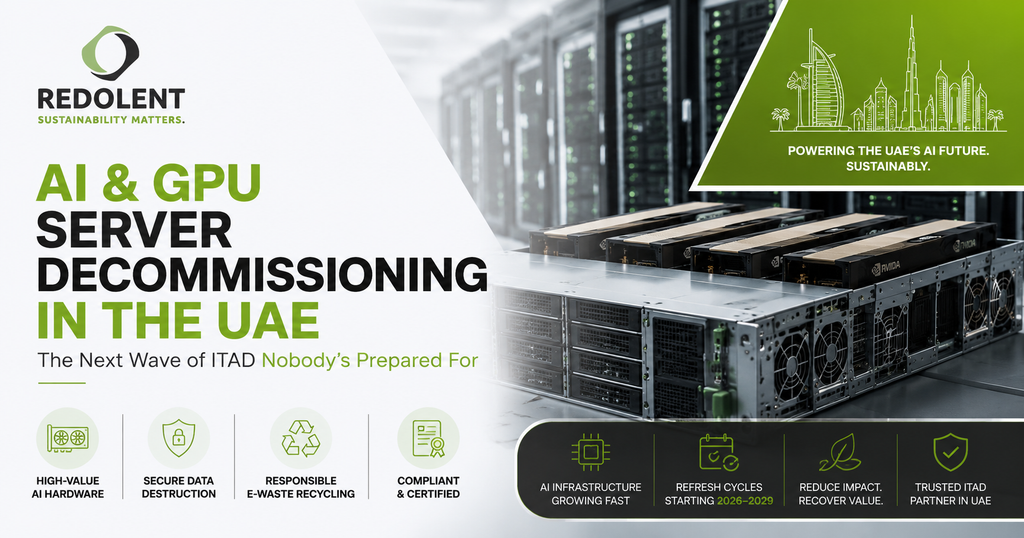
None of that hardware runs forever. Industry-wide, hyperscale operators typically refresh core server infrastructure every three to five years and because GPU deployment scaled so sharply between 2022 and 2024 globally, the first major wave of GPU-dense servers reaching end-of-life is expected between 2026 and 2029. The UAE’s build-out is newer and faster than most markets, which means local enterprises not just the hyperscale campuses are already sitting on ageing CPU-based infrastructure that’s being displaced by the AI transition, even before their own GPU hardware ages out.
In practice, that means two overlapping waves are hitting UAE IT departments at once: enterprises upgrading conventional servers to make room for AI workloads, and AI-forward organisations starting to retire their earliest GPU purchases. Both need a decommissioning partner who can tell the difference between the two.
What actually makes AI/GPU server decommissioning different
Direct answer: GPU decommissioning differs from standard server retirement in three ways recoverable value, data sensitivity, and physical handling — and treating it like ordinary IT asset disposal leaves money on the table and risk on the books.
1. The recoverable value is an order of magnitude higher. A four-year-old enterprise rack server with standard CPUs typically trades at a small fraction of its original price once depreciation and processing labour are factored in. GPUs behave completely differently a used NVIDIA H100, for example, has continued to trade at well over half its original price even two to three years after purchase. A generalist ITAD vendor pricing GPU-dense racks the same way they price a rack of old Dell PowerEdge servers can leave an organisation recovering a small fraction of what specialist handling would return.
2. The data footprint is denser and higher-stakes. AI training and inference infrastructure doesn’t just process data it retains it across GPUs, high-speed storage arrays, NVMe caches, and networking fabric, often for workloads involving proprietary models, customer data, or (in UAE contexts) data governed by PDPL, DIFC, or ADGM frameworks. Firmware-level data on GPUs and AI accelerators needs verified sanitisation, not just a drive wipe on the storage layer.
3. The physical and environmental handling is different. AI racks run at far higher power density than conventional servers, use different cooling architectures (including liquid cooling in newer deployments), and contain components — GPUs, high-bandwidth memory, specialised networking cards that require different dismantling, testing, and materials-recovery processes than a standard office server.
Who this affects in the UAE
This isn’t only a hyperscale-campus problem. It reaches:
- Enterprises and banks upgrading on-premise infrastructure to support AI workloads, retiring older server fleets in the process
- Government and semi-government entities standing up sovereign AI or data-residency infrastructure
- Data centre and colocation operators managing tenant hardware refresh cycles
- Healthcare and research institutions adopting AI-assisted diagnostics or research compute, with PHI-adjacent data exposure
- System integrators and resellers who take AI hardware in on trade-in or upgrade programs and need a compliant downstream partner
If your organisation touched an AI infrastructure decision in the last two years, a hardware retirement decision is coming, whether that’s this quarter or in 2027.
Getting it right: what a proper AI/GPU decommissioning process looks like
Direct answer: A compliant process separates high-value GPU assets from general e-waste streams, verifies sanitisation at the firmware level, maintains full chain-of-custody documentation, and only then moves to resale, refurbishment, or certified recycling.
- Asset identification and segregation — GPUs, AI accelerators, and high-density servers are flagged and separated from general IT scrap the moment they’re pulled from racks, not sorted later.
- Data sanitisation and destruction — firmware-level wipes verified against recognised standards, with physical destruction (including drilling) for storage media that can’t be securely wiped or that policy requires to be destroyed outright.
- Valuation and disposition path — working hardware is assessed for resale or refurbishment value before defaulting to recycling; this is where the recovery-value gap between generalist and specialist handling shows up most.
- Chain-of-custody documentation — every asset tracked from pickup to final disposition, with certificates of data destruction and recycling for audit, insurance, and ESG reporting purposes.
- Certified downstream processing — materials recovery through ISO-certified, environmentally compliant facilities, not informal scrap channels.
Frequently asked questions
Is GPU server decommissioning different from regular IT asset disposal? Yes. GPUs and AI-optimised servers carry significantly higher resale value, denser and more sensitive data, and different physical handling requirements than standard enterprise servers, so they need to be processed through a specialist workflow rather than a generic e-waste stream.
Can retired GPUs be resold instead of recycled? Often, yes. Because GPUs depreciate much more slowly than standard servers, many retired units still hold significant resale or refurbishment value and shouldn’t be defaulted straight to recycling without a proper valuation step.
What happens to the data on a decommissioned AI server? A compliant process sanitises data at the firmware level across GPUs, storage, and networking components, with physical destruction used for any media that can’t be verifiably wiped, and documented with a certificate of destruction.
Does this apply to smaller enterprises, or only hyperscale data centres? It applies to any organisation running on-premise AI infrastructure or standard servers being displaced by an AI upgrade — the scale changes the volume, not whether the process matters.
How often should businesses expect to refresh AI hardware? Industry norms point to roughly a three-to-five-year refresh cycle for core infrastructure, though AI-specific hardware can age out faster as newer chip generations offer significant efficiency and performance gains.
Redolent Group is an ISO 9001, ISO 14001, and ISO 45001-certified IT asset disposal and e-waste recycling company operating across all seven emirates, with secure data destruction (including M.2 SSD drilling) and full chain-of-custody documentation for enterprise, financial, healthcare, and data centre clients.