
When a Dubai hospital retires a PACS server, replaces a fleet of nursing station terminals, or decommissions an old imaging workstation, what’s leaving the building isn’t ordinary e-waste. It’s a device that has touched patient health information the kind of data the Dubai Health Authority (DHA) requires facilities to protect with the same rigor as active medical records, and retain proof of for 25 years. A single retired ultrasound console or EHR terminal can carry more regulatory exposure than an entire office’s worth of retired laptops from a non-healthcare business.
Most facilities don’t treat it that way. Equipment gets pulled from service, stacked in a storeroom or biomedical engineering closet, and eventually handed to whichever vendor offers the fastest pickup. For a bank or a logistics company, that’s a data risk. For a DHA- or DoH-licensed facility, it’s a compliance failure with your license attached to it.
Why Retired Medical IT Equipment Isn’t Ordinary E-Waste
Healthcare IT touches patient data in more places than most facilities realize. It’s not just the obvious systems it’s everything connected to them.
- PACS and imaging workstations — X-ray, MRI, CT, and ultrasound systems store diagnostic images tied to patient identifiers, often cached locally even when the primary archive is centralized
- EHR and nursing station terminals — local caches, temp files, and print spoolers routinely retain patient data long after the session ends
- Biomedical and monitoring devices — infusion pumps, patient monitors, and diagnostic equipment with embedded storage are frequently overlooked because they’re not thought of as “IT”
- Insurance and billing systems — POS terminals and claims-processing hardware hold financial data alongside clinical data, adding a second layer of exposure
- Servers and backup infrastructure — decommissioned NABIDH-integration servers or local backup appliances can hold full patient record sets, not fragments
A retired laptop from a marketing team might expose an email thread. A retired imaging workstation can expose a diagnosis, a treatment history, and an insurance claim — for potentially thousands of patients if it touched a shared archive.
What UAE Law Actually Requires
Healthcare providers in the UAE sit under more overlapping regulation than almost any other sector — medical regulation, financial regulation, and data protection regulation all apply at once, and they don’t always come from the same authority.
Federal level:
- UAE Federal Data Protection Law No. 45 of 2021 (PDPL) — the baseline data protection law covering personal data across the UAE, including health data as a sensitive category
- Federal Law No. 2 of 2019 (ICT Health Law) and its executive decisions — governs the use of information and communication technology specifically within the health sector
Emirate and authority level:
- DHA (Dubai) — enforces the Health Data Protection and Confidentiality Policy, requires facilities to appoint a Data Protection Officer, and mandates a minimum 25-year retention period for patient health records — which has direct implications for how long you need to be able to prove a device was properly wiped or destroyed, not just that it was
- DoH (Abu Dhabi) — parallel regulatory authority for healthcare facilities in Abu Dhabi, with its own licensing and data governance requirements
- MOHAP — covers healthcare facilities in the Northern Emirates
- DHCC Health Data Protection Regulation — a separate, more specific regulation for facilities licensed within Dubai Healthcare City
The practical consequence: a compliant ITAD process for a hospital or clinic needs to satisfy PDPL as a data protection baseline, the relevant health authority’s data governance policy, and produce documentation your facility can hold onto and produce on demand — potentially decades after the disposal event.
What Happens When This Goes Wrong
The risk isn’t hypothetical, and it isn’t limited to a single bad headline. For a DHA- or DoH-licensed facility, gaps in IT asset disposal create exposure on three fronts at once:
- Licensing risk — health authorities can tie facility license renewal to demonstrated compliance with data governance requirements, and an undocumented disposal process is a gap an auditor will find
- Breach notification obligations — if patient data is exposed through improperly disposed equipment, PDPL’s breach provisions apply, along with whatever notification requirements the relevant health authority imposes
- Reputational exposure that outlasts the incident — a data breach involving patient health information is a different category of story than a corporate data leak, and it follows a healthcare brand longer
None of this requires malicious intent. It requires a storeroom, a retired workstation nobody logged, and a scrap buyer with no data destruction paperwork.
What Compliant ITAD Looks Like for Healthcare Facilities
A defensible process for healthcare IT asset disposal has the same shape regardless of facility size the difference between a compliant hospital and an exposed one is usually whether each of these steps actually happened and was documented, not whether the equipment was “recycled.”
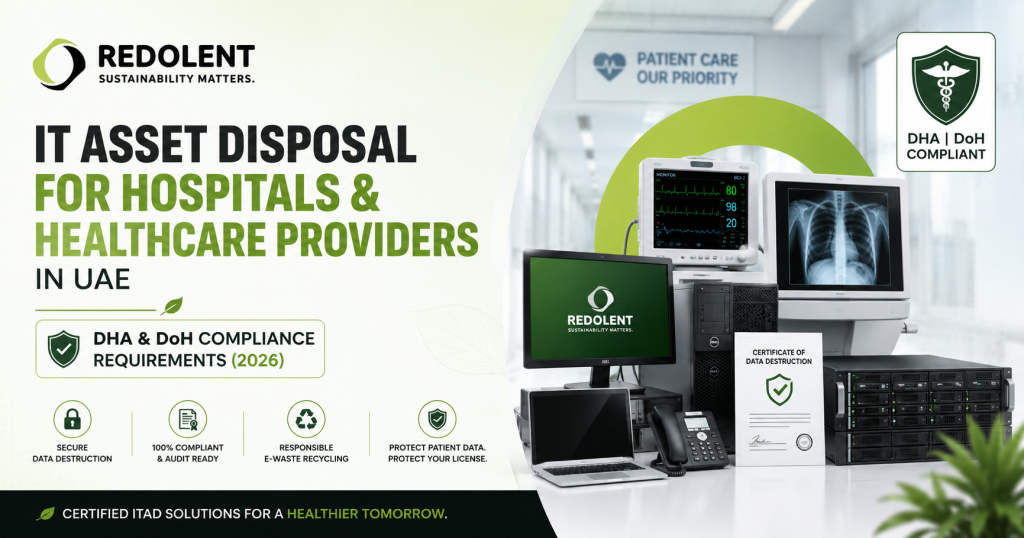
- Inventory and asset tagging — every device leaving clinical or administrative service gets logged before it’s moved, including devices not obviously thought of as “IT” (monitors, imaging consoles, biomedical devices with storage)
- Chain of custody from pickup to processing — the equipment is tracked from the moment it leaves your facility, not handed to a vehicle with no manifest
- Certified data destruction — wiping to a recognized standard, or physical destruction for drives that can’t be reliably sanitized, matched to the sensitivity of what the device held
- Certificate of data destruction, per asset — not a blanket statement, but documentation you can file against your DHA-mandated retention period and produce if audited
- Environmentally compliant recycling or refurbishment — for the physical hardware once data destruction is verified, aligned with UAE e-waste regulations
The certificate is the part facilities most often get wrong a general “we recycle responsibly” statement from a scrap buyer doesn’t hold up against a health authority audit. What holds up is a per-asset record you can match to your own inventory.
How Redolent Handles Healthcare IT Asset Disposal
Redolent Group is an ISO 9001, ISO 14001, and ISO 45001-certified ITAD and e-waste recycling company operating across all seven emirates, including dedicated data destruction services for equipment with sensitive storage down to physical drive destruction for drives where wiping isn’t sufficient. For healthcare clients, that means scheduled, documented pickups, chain-of-custody tracking from your facility to processing, and a certificate of destruction issued per asset not per shipment so it maps cleanly to whatever retention and audit requirements your facility operates under.
If your facility is sitting on retired imaging equipment, EHR terminals, or biomedical devices with no documented disposal process, that’s the gap worth closing before it becomes an audit finding.
Frequently Asked Questions
Does retired medical equipment count as e-waste in the UAE? Physically, yes but from a compliance standpoint, any device that stored or processed patient health information needs to be treated as a data asset first and e-waste second. Data destruction has to happen before recycling, and it needs to be documented.
Who regulates data protection for healthcare facilities in Dubai? The Dubai Health Authority (DHA) enforces health-sector-specific data governance requirements, alongside the UAE’s federal Personal Data Protection Law (PDPL Federal Law No. 45 of 2021) and the ICT Health Law (Federal Law No. 2 of 2019). Facilities within Dubai Healthcare City also fall under the separate DHCC Health Data Protection Regulation. Abu Dhabi facilities fall under DoH, and Northern Emirates facilities fall under MOHAP.
How long do healthcare facilities need to keep records of IT disposal? DHA policy sets a minimum 25-year retention requirement for patient health records, which in practice means facilities need disposal documentation certificates of destruction, chain-of-custody records — that can be retrieved on the same timeline, not just a receipt from the day of pickup.
What’s the difference between wiping and physical destruction for medical devices? Wiping (data sanitization) overwrites data on a drive that will be reused or resold. Physical destruction shredding or drilling is used when a drive can’t be reliably verified as sanitized, or when the sensitivity of the data warrants it regardless. A compliant ITAD provider should assess which is appropriate per device rather than applying one method to everything.
Can a general IT scrap buyer legally handle hospital equipment disposal? Not compliantly. A facility under DHA, DoH, or MOHAP oversight needs documented chain of custody and per-asset certificates of destruction something informal scrap buyers typically don’t provide. Using one shifts the compliance and breach-notification risk back onto the facility.