
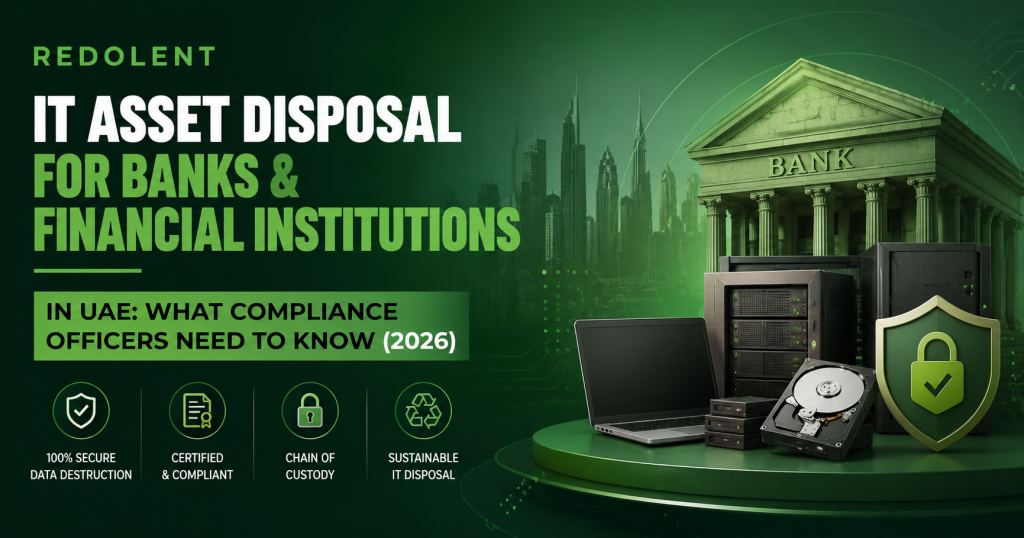
When a UAE bank retires a server rack, closes a branch, or upgrades its ATM fleet, the equipment leaving the building isn’t ordinary e-waste. It’s holding transaction records, customer KYC data, and account credentials. A single laptop or hard drive from a financial institution carries more liability than an entire office’s worth of scrap from most other industries.
For CISOs, compliance officers, and operations managers at UAE banks, exchange houses, and financial services firms, choosing how retired IT assets are disposed of isn’t a procurement decision. It’s a regulatory one.
Why financial institutions can’t treat this like regular e-waste
Banks operating in the UAE sit under multiple overlapping obligations: the UAE’s Personal Data Protection Law (PDPL, effective since 2022), Central Bank of the UAE data governance expectations, and internal audit requirements that most other sectors never face. A retired hard drive that isn’t destroyed to a verifiable standard is an open compliance finding waiting to happen — and in banking, audit findings escalate fast.
The risks of getting this wrong go beyond fines. A recovered drive from a decommissioned branch, if it ends up in the wrong hands, can mean customer data exposure, reputational damage that’s difficult to reverse in a small market like the UAE, and scrutiny from regulators who are increasingly attentive to data lifecycle management.
What secure ITAD actually requires for a bank
Not every recycling vendor is equipped to handle financial-sector equipment. Before handing over retired assets, banks should confirm their disposal partner provides:
- Certified data destruction — degaussing or physical shredding of drives to NIST 800-88 standards, not just factory reset or formatting
- Certificate of destruction per asset — a serialized record for every drive, not a blanket confirmation for the whole batch
- Chain of custody documentation — tracking equipment from pickup to final destruction, so there’s no gap an auditor can question
- On-site destruction option — for highly sensitive environments, drives are destroyed at the branch or data center before they ever leave the premises
- ISO-certified processes — recognized quality, environmental, and safety management systems behind the operation, not just a claim on a website
- Asset inventory reporting — a full manifest of what was collected, by serial number, useful for both internal audit and insurance purposes
Common scenarios we handle for financial clients
Branch consolidations are one of the most frequent triggers — when a bank closes or merges branches, every workstation, POS terminal, network switch, and often a small server room needs to be cleared on a timeline set by the lease, not by IT’s convenience. ATM fleet upgrades are another: decommissioned ATMs contain hard drives and sometimes cash-handling modules that require destruction records separate from the rest of the equipment. Data center and server room decommissioning tends to be the highest-stakes scenario, involving racks of drives that each need individual destruction certificates rather than a single batch confirmation. Day-to-day IT refresh cycles round this out, as laptops, desktops, and networking equipment reach end-of-life on a rolling basis and need a repeatable, auditable process rather than one-off handling each time.
What the process looks like with Redolent Group
Redolent Group is ISO 9001:2015, ISO 14001:2015, and ISO 45001:2018 certified, and works across all 7 emirates with a dedicated facility in Umm Ramool, Dubai. For financial sector clients, the process typically runs:
- Scoping call — understanding the volume, asset types, and whether on-site destruction is required
- Scheduled, secure collection — GPS-tracked transport, sealed containers for drives
- Destruction — degaussing/shredding on-site or at the certified facility, per the agreed method
- Certification — serialized certificates of destruction issued per drive, plus a full asset manifest
- Environmentally compliant recycling — remaining materials processed responsibly, closing the loop
Frequently Asked Questions
Does Redolent provide on-site data destruction for banks?
Yes. For clients who cannot let drives leave the premises un-destroyed, degaussing or shredding can be performed on-site before transport.
What certification standard do you follow for data destruction?
Drives are destroyed to NIST 800-88 guidelines, with a serialized certificate of destruction issued per asset.
Can you handle a full branch closure on a tight timeline?
Yes — branch consolidations are one of our most common financial-sector engagements. Collection is scheduled around the lease or handover deadline.
Is there a minimum volume for financial institution clients?
No minimum. We handle everything from a single decommissioned server rack to multi-branch consolidations.
How is pricing structured for bulk decommissioning?
Pricing depends on volume, asset type, and whether on-site destruction is required. Contact us for a scoped quote.