
Every UAE business eventually retires laptops, servers, and hard drives. But before that equipment leaves the office, it usually still holds customer records, financial data, or internal documents. Wiping a drive with free software or handing it to a scrap dealer is not enough anymore. Since 2022, the UAE’s Personal Data Protection Law (PDPL), along with sector-specific rules from the DIFC and ADGM free zones, has made secure, documented data destruction a legal requirement rather than a best practice.
This guide breaks down what each regulation actually requires, what “certified” data destruction means in practice, and how Redolent Group helps UAE businesses stay compliant while retiring old IT assets responsibly.
Why Data Destruction Became a Compliance Issue
The UAE’s push toward a digital economy has been matched by tighter data protection rules. Federal Decree-Law No. 45 of 2021 on the Protection of Personal Data (PDPL) applies to any business processing personal data connected to the UAE, whether that data lives on a server rack or a decommissioned laptop. If a discarded hard drive is later recovered and read by a third party, the data controller can be held liable for the breach, regardless of intent.
Free zones layer on their own obligations. The DIFC Data Protection Law (DIFC Law No. 5 of 2020) and the ADGM Data Protection Regulations 2021 both apply to companies licensed within those jurisdictions and carry their own breach notification and accountability requirements. A business operating across mainland Dubai and a DIFC-registered entity may need to satisfy more than one framework at once.
What “Certified” Data Destruction Actually Means
Certified destruction is not a marketing label — it refers to a documented process that can be audited after the fact. At minimum, it should include:
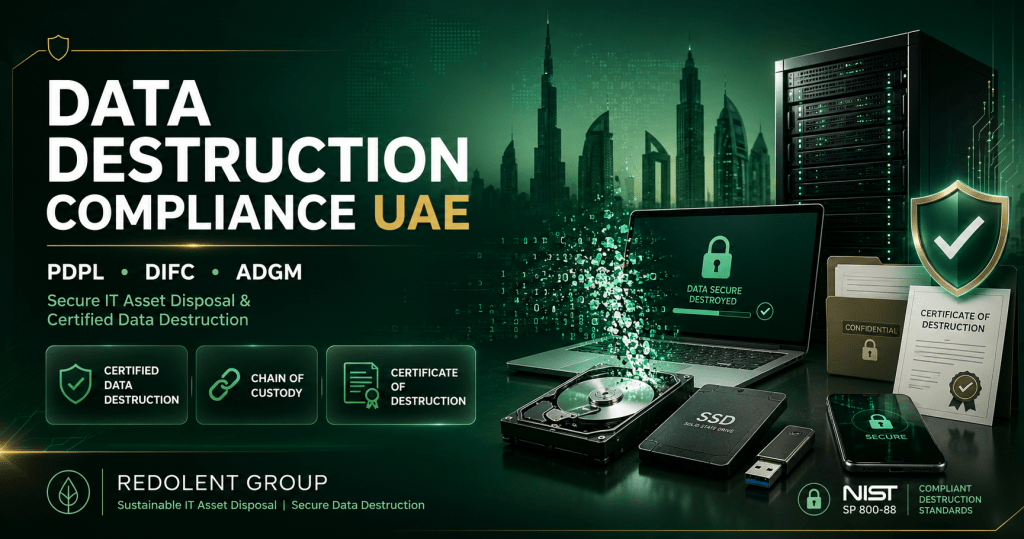
- A destruction method aligned with NIST SP 800-88 guidelines (Clear, Purge, or Destroy, depending on the media and its sensitivity)
- Chain-of-custody tracking from pickup to final destruction, so every asset is accounted for
- A certificate of destruction listing serial numbers, method used, and date, issued for each batch of assets
- Physical destruction (shredding) for drives that cannot be securely wiped, with on-site witnessing available on request
PDPL, DIFC, and ADGM: A Quick Comparison
- PDPL (federal/mainland): applies broadly to personal data processing across the UAE; requires appropriate technical and organizational measures to protect data, including at disposal
- DIFC Law No. 5 of 2020: applies to DIFC-registered entities; requires demonstrable accountability and record-keeping for how personal data is processed and destroyed
- ADGM Data Protection Regulations 2021: closely modeled on GDPR; requires data minimization and secure disposal once data is no longer needed for its original purpose
Businesses that operate in more than one of these jurisdictions should default to the strictest applicable standard rather than trying to track three separate policies.
What This Looks Like in Practice
For most UAE businesses, staying compliant does not require an in-house data destruction program. It requires a vetted partner who can pick up retired IT assets, destroy the data on-site or at a secure facility, and issue paperwork that would hold up if a regulator asked for it. Redolent Group handles this as part of its IT Asset Disposal (ITAD) service across all seven emirates, covering laptops, servers, mobile devices, and M.2/SSD drives with NIST-aligned destruction and a certificate for every job.
Key Takeaway
Data destruction is no longer just an IT housekeeping task in the UAE — it is a compliance obligation tied directly to PDPL, DIFC, and ADGM data protection rules. The safest approach is working with a certified ITAD partner who can prove, on paper, that every retired device was handled correctly
Book a free, certified data destruction pickup with Redolent Group