
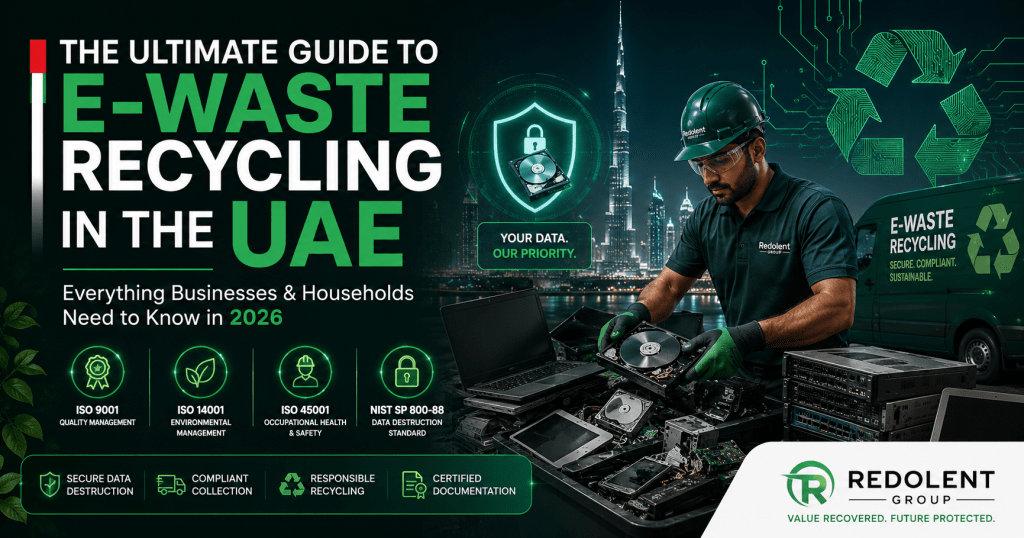
Every laptop that stops turning on, every phone traded in for a newer model, every server rack retired during an office move — all of it becomes e-waste the moment it’s unplugged for the last time. Globally, this is now the fastest-growing waste stream on the planet.
The world generated a record 62 million tonnes of e-waste in 2022 up 82% from 2010 and that figure is projected to climb to 82 million tonnes by 2030. Yet only 22.3% of it was formally collected and recycled, leaving an estimated USD 62 billion in recoverable metals, plastics, and rare materials lost to landfills, informal scrap yards, or illegal export each year.
The UAE is not exempt from this trend. As one of the most digitally connected economies in the Gulf, Dubai, Sharjah, and the wider Emirates generate enormous volumes of decommissioned IT equipment every year — from corporate laptop refreshes to personal phone upgrades. The difference between this waste becoming an environmental liability or a recovered resource comes down to one decision: who you trust to recycle it.
This guide breaks down exactly how e-waste recycling works in the UAE, what the law requires, what “certified” actually means, and how to choose a recycler that won’t leave your business exposed to data breaches or compliance risk.
What You’ll Learn in This Guide
- What counts as e-waste — and why it’s more than just “old electronics”
- Why improper disposal is a legal, environmental, and security risk in the UAE
- The UAE’s e-waste laws: Federal Law No. 12 of 2018 and Dubai’s regulatory landscape
- Step-by-step: what actually happens to your device once it’s recycled
- How to identify a genuinely certified e-waste recycler (and spot the ones that aren’t)
- Data security: why deleting files is not the same as destroying data
- E-waste recycling for businesses vs. households in the UAE
- A practical checklist before you hand over your old IT equipment
1. What Counts as E-Waste? (It’s More Than Old Laptops)
E-waste, or Waste Electrical and Electronic Equipment (WEEE), covers any device with a plug, battery, or circuit board that has reached the end of its usable life. In a UAE office or household, that typically includes:
- Laptops, desktops, monitors, and servers
- Mobile phones, tablets, and smartwatches
- Networking hardware — routers, switches, IP phones, access points
- Hard drives, SSDs, and other storage media
- Printers, scanners, and office peripherals
- Batteries, power banks, and UPS units
- Point-of-sale systems, CCTV equipment, and access control devices
Each category carries a different mix of recoverable materials (copper, gold, aluminium, rare earth elements) and hazardous components (lead, mercury, brominated flame retardants). This is precisely why e-waste cannot be treated like ordinary office trash — and why regulators across the UAE increasingly require documented, traceable disposal.
It helps to think of e-waste in three broad tiers, because each one is processed differently:
- Small IT and consumer devices — phones, tablets, routers, and small peripherals. Globally, this category made up roughly 4.6 million tonnes of e-waste in 2022, yet only around 22% of it was documented as formally collected and recycled, largely because these devices are small enough to be thrown in general waste without a second thought.
- Large IT equipment — desktops, servers, monitors, and networking racks. These typically have higher recovery rates because their size makes them harder to discard casually and their components (aluminium chassis, copper wiring, circuit boards) carry meaningful resale value.
- Batteries and power equipment — UPS units, power banks, and laptop batteries. These require separate handling because of fire risk and the hazardous chemicals they contain, and should never be placed in general recycling streams.
For most UAE businesses, the bulk of retired equipment falls into the first two tiers — laptops, monitors, networking hardware — which is exactly the category where informal “scrap collectors” are most active and certified recyclers are most necessary.
2. Why Improper E-Waste Disposal Is a Real Risk — Not Just an Environmental One
Regional scale of the problem
The Middle East is not a small contributor to this picture. The region produces roughly 150 million tonnes of municipal solid waste annually, with the UAE and Saudi Arabia among the largest contributors, and individuals in the Middle East generate more total waste than the global average. As the UAE’s population and device density keep climbing — driven by a tech-forward consumer base, a large expatriate workforce replacing devices on relocation, and one of the highest smartphone penetration rates in the world — the volume of retired electronics flowing through Dubai, Sharjah, and Abu Dhabi each year continues to grow.
Environmental impact
Electronic devices contain hazardous substances — lead in circuit boards, mercury in flat-panel displays, and brominated flame retardants in plastics — that leach into soil and groundwater when dumped in landfills. At a global level, non-compliant e-waste management releases an estimated 58,000 kg of mercury and 45 million kg of plastic-bound flame retardants into the environment every year.
Data security risk
This is the risk most UAE businesses underestimate. A decommissioned laptop, server, or phone is not just hardware — it’s a container for financial records, customer data, credentials, and proprietary files. Devices that are resold, scrapped, or discarded without certified data destruction create a direct exposure point for data breaches, regardless of how the unit was originally “wiped.”
This risk compounds at scale. A single retired laptop is one exposure point; a company refreshing 200 workstations during an office relocation is 200 potential exposure points, often handled in a rush, by whichever vendor happens to be available, with little thought given to what’s actually stored on each drive. The larger the IT refresh, the more this becomes a structured data-governance task rather than a simple disposal errand.
Economic loss
There’s also a quieter cost: value destruction. Globally, the raw materials embedded in e-waste were valued at roughly USD 91 billion in 2022, yet only about USD 28 billion was actually recovered through proper recycling. Every laptop or server scrapped informally instead of processed through certified material recovery is, in effect, raw copper, gold, and aluminium being thrown away rather than reclaimed — value that responsible recyclers can return to the supply chain, and in some cases, return to you as resale credit.
Regulatory and reputational risk
Under the UAE’s Personal Data Protection Law (PDPL), organisations are accountable for how personal data is handled throughout its lifecycle — including disposal. A breach traced back to an improperly disposed device is treated as a compliance failure, not an accident. For businesses handling customer or employee data, this makes IT Asset Disposition (ITAD) a governance issue, not just a housekeeping task.
3. The UAE’s Legal Framework for E-Waste
The UAE has steadily formalised its approach to electronic and hazardous waste over the past decade:
- Federal Law No. 12 of 2018 on Integrated Waste Management — sets out requirements for the segregation, treatment, and reduction of hazardous waste, including e-waste, under the supervision of the relevant authority.
- Cross-border movement restrictions — the UAE’s Ministry of Climate Change and Environment prohibits the unauthorised export of hazardous waste across its borders, in line with the Basel Convention, meaning e-waste cannot simply be shipped overseas without written permission.
- Emirate-level enforcement — individual emirates, including Dubai and Sharjah, layer additional municipal requirements on top of federal law, particularly for commercial waste generators.
- UAE PDPL — while not a waste law, it creates a direct compliance obligation around how data-bearing devices are retired and destroyed.
For businesses, the practical implication is simple: e-waste disposal needs to be documented. A verbal assurance that equipment was “recycled” doesn’t hold up under audit. What’s required is a certificate of destruction or recycling, ideally tied to internationally recognised standards.
It’s also worth noting how this regulatory picture has evolved. The UAE’s broader environmental strategy has long included aggressive landfill diversion targets — Sharjah, for instance, set an early goal of 100% landfill diversion through dedicated waste management infrastructure, a model that has pushed other emirates toward similar formal recycling systems rather than relying on landfill as the default outcome for any waste stream, electronics included. The direction of travel across the UAE is consistently toward more structured, more auditable waste handling — and e-waste, given its hazardous and data-security dimensions, sits near the front of that shift.
4. What Actually Happens When You Recycle E-Waste in the UAE
A properly certified recycling process looks very different from simply dropping a box of old laptops at a scrap dealer. Here’s the typical lifecycle:
- Collection — equipment is picked up from your office or home, ideally with a chain-of-custody log starting at the point of collection.
- Inventory and data-bearing asset identification — every device is logged, and anything with storage media is flagged for secure data destruction before any further processing.
- Data destruction — hard drives, SSDs, and mobile storage are wiped or physically destroyed in line with recognised standards such as NIST SP 800-88.
- Manual disassembly — devices are broken down into component streams: metals, plastics, circuit boards, batteries, and glass.
- Material recovery — each stream is processed to recover reusable raw materials (copper, aluminium, gold, rare earth elements) for re-entry into manufacturing supply chains.
- Hazardous material handling — components like batteries and mercury-containing parts are isolated and treated separately to prevent environmental contamination.
- Certification — a certificate of data destruction and/or recycling is issued, giving you an auditable record for compliance purposes.
This is the difference between informal scrapping and certified ITAD: traceability at every step, not just a promise that the equipment “got recycled somewhere.”
5. How to Identify a Genuinely Certified E-Waste Recycler in the UAE
“Certified” is one of the most overused words in the recycling industry. Before trusting a vendor with your retired IT assets, verify these specifics rather than taking the label at face value:
| Ask for | Why it matters |
|---|---|
| A valid ISO 9001 certificate | Confirms a documented quality management system governs how the recycler operates, not just a one-off claim. |
| A valid ISO 14001 certificate | Confirms an environmental management system is in place to control pollution and hazardous material handling. |
| A valid ISO 45001 certificate | Confirms occupational health and safety standards are followed during disassembly and processing. |
| Certificate issuer and expiry date | Certificates lapse. Ask which accredited body issued it and confirm it is currently valid — not expired. |
| Data destruction standard used | Look specifically for alignment with NIST SP 800-88, the recognized benchmark for media sanitization. |
| A documented chain of custody | You should be able to trace your equipment from pickup to final disposition, not just receive a generic letter. |
Redolent Group operates under ISO 9001:2015, ISO 14001:2015, and ISO 45001:2018 certification issued via IMCD Certification, valid through September 2028, with data destruction processes aligned to NIST SP 800-88. You can review the full certification scope on our certifications page before booking a collection.
6. Data Security: Why “Deleting Files” Isn’t Data Destruction
One of the most persistent misconceptions in IT asset disposal is that formatting a drive, deleting files, or even doing a factory reset is sufficient. It isn’t. Standard deletion removes the file system’s pointer to the data — the data itself typically remains physically present on the storage medium and is recoverable with widely available forensic tools.
Certified ITAD providers address this in one of two ways:
- Secure data wiping — overwriting every sector of a drive multiple times using software aligned with NIST SP 800-88 guidelines, suitable for drives being resold or reused.
- Physical destruction — shredding, crushing, or degaussing drives that cannot or should not be returned to circulation, typically used for high-sensitivity data.
For businesses retiring servers, point-of-sale systems, or employee laptops, the correct approach depends on whether the asset has resale value and how sensitive the data was. A reputable recycler will ask before assuming, and will issue a certificate of destruction naming the method used and the serial numbers processed.
7. E-Waste Recycling for Businesses vs. Households
For businesses
Corporate IT asset disposition involves volume, data sensitivity, and audit requirements that household disposal doesn’t. A typical business engagement includes scheduled bulk pickups, asset tagging and inventory reporting, secure data destruction with certificates per device or per batch, and value recovery where equipment still has resale potential — sometimes offsetting disposal costs entirely.
For households
Individuals retiring a personal laptop, phone, or old router have simpler needs but the same core risk: personal photos, banking apps, saved passwords, and identity documents often sit on these devices long after they’re “cleared.” A trustworthy household drop-off or pickup service should still confirm how data destruction is handled, even for a single device.
Redolent Group services both segments across the UAE, including dedicated service pages for Sharjah and Ajman, alongside Dubai-based collection.
8. Practical Checklist Before You Hand Over Your Old IT Equipment
- Confirm the recycler’s ISO 9001, ISO 14001, and ISO 45001 certificates are current and issued by an accredited body
- Ask which data destruction standard they follow (look for NIST SP 800-88 alignment)
- Request a certificate of data destruction or recycling for your records
- Get serial numbers logged at collection, not just a generic pickup receipt
- Ask what happens to hazardous components like batteries and mercury-containing parts
- For businesses: clarify whether any equipment qualifies for resale value recovery
- Keep documentation on file in case of a PDPL-related audit or data inquiry
Frequently Asked Questions
Yes, in practice. Federal Law No. 12 of 2018 on Integrated Waste Management requires the proper segregation, treatment, and reduction of hazardous waste, which includes most categories of electronic equipment. Businesses generating IT waste at scale are expected to manage disposal responsibly rather than placing it in general waste streams, and emirate-level municipal authorities may impose additional requirements.
If a device still has functional value, resale is a legitimate part of the e-waste lifecycle because it extends the product’s useful life. However, data security comes first. Any device being resold should undergo certified data sanitization before transfer. A factory reset alone is not enough. Reputable ITAD providers determine whether a device should be reused, refurbished, resold, or recycled.
Secure wiping typically follows NIST SP 800-88 guidelines, overwriting data so it cannot be recovered. When data sensitivity is high, physical destruction methods such as shredding or crushing may be used. A certified recycler should provide documentation confirming the destruction method used.
Pricing depends on the quantity, type, and condition of equipment being disposed of. In some cases, the resale value of recoverable devices can offset collection and processing costs. For households, a flat pickup fee may apply. Always request a detailed quote that separates collection, data destruction, and material recovery charges.
E-waste recycling focuses on dismantling equipment and recovering valuable materials. ITAD is a broader process that includes secure data destruction, asset tracking, compliance reporting, refurbishment, resale, and final recycling. Businesses handling laptops, servers, and storage devices typically require ITAD services rather than simple recycling.
Documentation is recommended regardless of volume. For household devices, a simple confirmation of data destruction may be sufficient. For business equipment, serial-number-level tracking and a formal Certificate of Destruction provide essential audit and compliance records.