
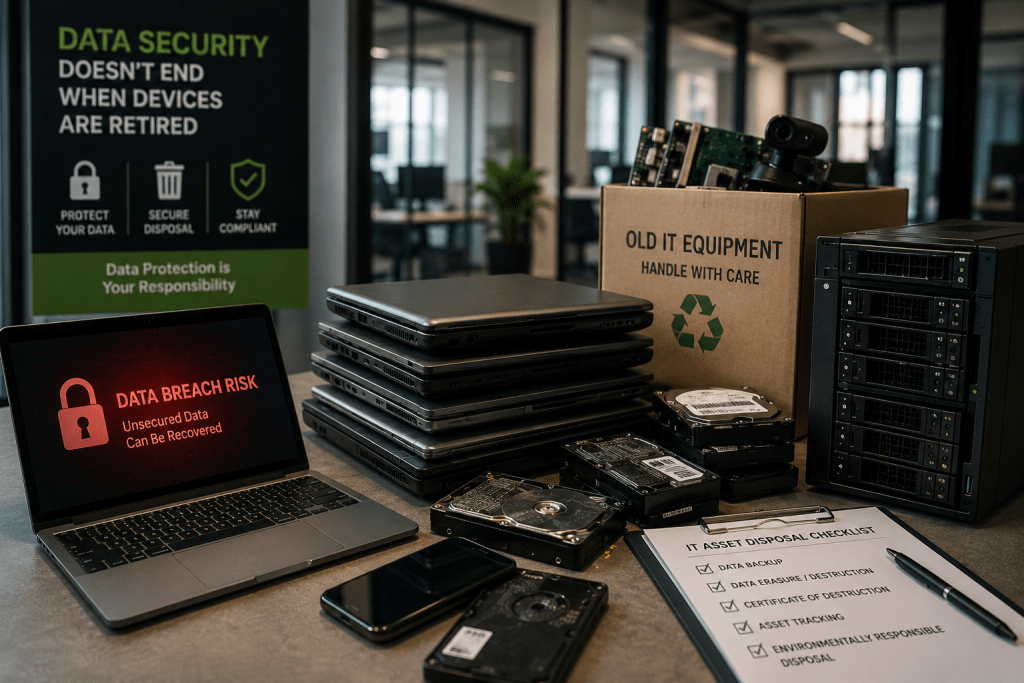
Walk into the back room of almost any office in Dubai and you will find it: a stack of old laptops nobody got around to wiping, a dead server pushed into a corner during the last office move, a box of phones that used to belong to staff who left the company months ago. Nobody thinks of that pile as a security risk. It is one of the biggest risks your company is carrying right now.
Most businesses in the UAE have invested heavily in firewalls, antivirus software, and cloud security. Far fewer have a plan for what happens to the physical devices once they are replaced. That gap is exactly where data breaches, compliance fines, and reputational damage start.
The Disposal Blind Spot Most UAE Companies Don’t See
Information security teams spend their budget protecting data while it is in use. The moment a laptop, server, or phone is taken out of service, that same level of attention usually disappears. Equipment gets stacked in storerooms, handed to office staff to “figure out,” or sold informally to whoever offers the best price for scrap metal and components.
None of those routes include a verified data wipe. None of them produce a record you can show a regulator, a client, or an auditor. And under UAE law, that gap is now a liability your business carries personally.
What UAE’s Data Protection Law Actually Requires
The UAE Personal Data Protection Law (Federal Decree-Law No. 45 of 2021), known as the PDPL, applies to any business that processes the personal data of people in the UAE, regardless of company size or sector. It does not stop applying once a device is “old” or scheduled for disposal a company remains responsible for personal data until it can demonstrate that data has been securely and permanently destroyed.
Under the PDPL, the UAE Data Office can impose administrative fines that climb well into six figures, with the most serious or repeat violations reaching into the millions of dirhams. Businesses are also expected to report qualifying breaches within a short window of becoming aware of them. “We didn’t know the old laptop still had customer data on it” is not a recognized defense — it is the exact scenario the law is designed to prevent.
How a “Disposed” Hard Drive Becomes a Live Data Breach
Deleting a file does not erase it. Formatting a drive does not erase it either both simply remove the index that tells the device where to find the data, while the underlying information remains fully recoverable with widely available, low-cost software. A drive that looks “wiped” to an employee can still hand over invoices, contracts, payroll records, or customer details to whoever buys it next.
It is not only laptops and servers. Photocopiers, scanners, point-of-sale terminals, networking equipment, and old smartphones all store data on internal drives that are routinely overlooked when equipment is cleared out and routinely missed by anyone who isn’t specifically trained to look for them.
Once equipment leaves your office through an informal channel, there is no chain of custody. Nobody can confirm where it went, who opened it, or whether the data inside was ever touched. If that information later surfaces in a breach, your business has no documentation to show regulators that reasonable safeguards were in place.
Three Risk Scenarios Every Dubai Business Should Recognize
The scenarios below are illustrative examples built from common disposal patterns seen across UAE businesses not reports of specific incidents but each one reflects a routine, everyday decision that creates real exposure.
- A professional services firm clears out 30 retired laptops during an office upgrade and sells them as a bulk lot to a local trader to save time. No wipe is performed or verified. The drives still hold years of client financial records.
- A clinic decommissions an old patient-management server after migrating to new software. The server sits untouched in a storeroom for a year, then gets handed off for disposal along with general office junk with no one checking what data is still on it.
- A free zone trading company allows a departing employee to keep their old company phone as a goodwill gesture. The phone is never factory reset by IT, and it still contains saved supplier contacts, contracts, and internal correspondence.
Certified ITAD vs. Selling to a Local Scrap Buyer
The price difference between a certified IT Asset Disposition (ITAD) partner and an informal scrap buyer is usually small. The risk difference is not.
Certified ITAD vs. Selling to a Local Scrap Buyer
The price difference between a certified IT Asset Disposition (ITAD) partner and an informal scrap buyer is usually small. The risk difference is not.
| What Happens | Redolent Group (Certified ITAD) | Informal / Local Scrap Buyer |
|---|---|---|
| Data wipe before resale or recycling | Certified erasure or physical destruction, every device | Rarely performed or unverifiable |
| Proof of destruction | Certificate of Data Destruction issued per batch | No documentation provided |
| Chain of custody | Logged from pickup to final destruction | No tracking once it leaves your office |
| Legal liability | Documented compliance supports your PDPL defense | Liability stays fully with your company |
| Where devices end up | Certified recycling or audited refurbishment | Often resold on the grey market, data intact |
| Environmental compliance | Aligned with UAE e-waste regulations | Untracked, no compliance record |
How Redolent Group Removes This Risk Completely
Redolent Group handles secure IT asset disposal for businesses across Dubai and the wider UAE, built around one principle: nothing leaves your office until the data risk has already been eliminated.
- Certified data erasure or physical destruction (shredding/degaussing) for every drive collected
- A Certificate of Data Destruction issued for each batch, for your compliance and audit files
- Documented chain of custody from the moment equipment is collected to final destruction
- Environmentally compliant e-waste recycling once data destruction is complete
- Free pickup across Dubai, with coverage extending to other Emirates for bulk and corporate clients
A 5-Point Compliance Checklist Before You Dispose of Any IT Equipment
- Inventory every device leaving service — laptops, servers, phones, copiers, and POS terminals all count.
- Confirm whether the device ever stored customer, employee, or financial data.
- Use a certified data destruction partner — never an informal buyer or unverified third party.
- Request a Certificate of Data Destruction for every batch and keep it in your compliance file.
- Retain chain-of-custody records in case you ever need to demonstrate compliance to the UAE Data Office.
Frequently Asked Questions
Does deleting files or formatting a drive count as secure data destruction?
No. Both actions remove the file index, not the underlying data, which remains recoverable with widely available software. Secure destruction requires certified erasure software or physical destruction of the storage media.
What is a Certificate of Data Destruction, and do I actually need one?
It is a formal record confirming when, how, and by whom a device’s data was destroyed. It is the document you would present to a regulator, auditor, or client to demonstrate PDPL compliance — without it, you have no proof the data was ever handled responsibly.
My company is small — does the PDPL still apply to us?
Yes. The PDPL applies based on whether you process personal data belonging to people in the UAE, not on company size. A small business with customer or employee records carries the same data destruction obligations as a large enterprise.
Can Redolent collect old IT equipment from multiple Dubai offices at once?
Yes. Redolent regularly handles multi-site and bulk collections for corporate clients, including coordinated pickups across several office locations on a single schedule.
How quickly can equipment be wiped and removed from our premises?
Most standard pickups in Dubai can be scheduled within 24–48 hours. Larger or multi-site collections are coordinated around your timeline, with data destruction beginning as soon as equipment reaches Redolent’s facility.
Don’t Let a Forgotten Hard Drive Become a Million-Dirham Problem
Get a free, no-obligation IT asset pickup and secure data destruction quote for your Dubai office.